
Foreign Coins Worth Money: Rare World Coins And Valuable Coins To Check

If you have a jar of old foreign coins, inherited world coins or random coins from travel, do not assume they are worthless. Some foreign coins are common souvenirs, but others can be worth real money because of rarity, metal content, condition, mint errors or collector demand.
The tricky part is that a coin being old or foreign does not automatically make it valuable. I always check the country, date, denomination, mint mark, metal, condition and recent sold prices before deciding whether a coin is worth keeping, selling or researching further.
In this 2026 guide, I’ll show you which foreign coins and valuable coins are worth checking, what details can affect price and why auction records are useful but not always realistic for the coins you may actually find.
TL;DR: Foreign Coins Worth Money In 2026
- Foreign coins can be worth money: Some world coins are valuable because of rarity, condition, metal content, mint errors, low mintage or collector demand.
- Old does not always mean valuable: I would not assume a coin is rare just because it looks old or comes from another country.
- Check the basics first: Look at the country, date, denomination, mint mark, metal and condition before searching for values.
- Condition matters: A clean, original, high-grade coin usually has more collector appeal than a damaged, scratched or heavily worn coin.
- Sold prices matter most: I would compare recent sold prices instead of relying only on asking prices online.
- Auction records are not normal values: Million-dollar coin sales are useful for context, but most coins you find will be worth much less.
- Silverpicker’s rule: Identify the coin first, then check rarity, condition and real market demand before keeping, selling or spending it.
What Foreign Coins Are Worth Money?
Foreign coins can be worth money when they have the right mix of rarity, condition, metal content, mint errors, low mintage or strong collector demand. I would not judge a coin by age alone. Some old foreign coins are common, while newer world coins can be valuable because of errors, silver content or limited production.
When I check a foreign coin, I look at these details first:
- Country – The country helps you identify the coin and compare it with the right market.
- Date – Certain years are more collectible because of low mintage, design changes or historical events.
- Denomination – The face value can help narrow down the exact coin type.
- Mint mark – Some mint marks are scarcer than others.
- Metal content – Silver, gold and other metals can give a coin base value even before collector demand.
- Condition – A sharp, original coin usually has stronger appeal than one that is scratched, cleaned, bent or heavily worn.
- Errors and varieties – Wrong planchets, doubled designs, off-center strikes and other mistakes can make a coin more collectible.
- Recent sold prices – I always compare actual sold listings because asking prices can be unrealistic.
The foreign coins most worth checking are usually silver coins, gold coins, low-mintage world coins, colonial coins, error coins and coins tied to major historical periods. If you find a foreign coin you do not recognize, identify it first before assuming it is rare or worthless.
How I Check If A Foreign Coin Is Valuable
When you find a foreign coin, do not start by asking, “How old is it?” Start by identifying exactly what you have. A coin’s value depends on the specific country, date, denomination, mint mark, metal, condition and demand.
Here is the simple process I use:
- Identify the country – Look for words, symbols, rulers, flags, shields or national emblems that tell you where the coin came from.
- Find the date – Some foreign coins use different calendars, so the date may not always look like a standard Western year.
- Check the denomination – The number on the coin helps you compare it with the right type, size and metal.
- Look for a mint mark – A small letter, symbol or mark can sometimes separate a common coin from a scarcer one.
- Check the metal – Silver and gold coins may have melt value, while base-metal coins usually depend more on rarity and collector demand.
- Inspect the condition – Scratches, cleaning, holes, bends and heavy wear can hurt value. Sharp details and original surfaces usually help.
- Search recent sold prices – I would compare your coin with examples that actually sold, not just listings with high asking prices.
This step matters because many foreign coins look exciting at first, but only a smaller number have strong collector value. Once you identify your coin correctly, the value research becomes much easier.
Coins Worth Millions – the 10 Most Valuable Coins
Some coins sell for millions because they have the right mix of rarity, history, condition and demand. These are not normal pocket-change finds, but they are useful examples because they show what collectors and major auction buyers care about most.
When I look at record-breaking coins, I do not treat the sale price as a normal value guide. A famous coin with a documented history, tiny surviving population or elite grade can sell for far more than a similar-looking coin you might find in a collection.
Use the list below as a high-level reference for what makes the world’s most valuable coins stand out:
| Coin | Country | Original value | Current Value |
| 1933 Double Eagle | USA | $20 | $18.9 million |
| 1794 Flowing Hair Dollar | USA | $1 | $12 million |
| 1787 Brasher Doubloon | USA | $20 | $10-12 million |
| 1861 Paquet Liberty Head double eagle | USA | $20 | $7.2 million |
| 1903 Fengtien Tael | China | $20 | $6.9 million |
| 1913 Liberty Head Nickel | USA | $0.05 | $5 million |
| Umayyad Gold Dinar | (Umayyad Caliphate) | $4 | $5 million |
| 1723 Portuguese 400 Reis (Olhos de Boi) | Portugal | $26 | .7 million |
| 1797 Gold Guinea | Great Britain | $1 | $2.5 million |
| 1804 Draped Bust Dollar | USA | $1 | $2-3 million |
Major Coin Auction Sales: What Recent Results Can Teach You
Major auction results can help you understand what serious collectors value, but they should not be treated as normal price guides. Coins that sell for huge amounts usually have exceptional rarity, elite condition, strong provenance or major historical importance.
When I study auction results, I look for patterns instead of assuming every similar coin is worth the same amount. The most important clues are usually rarity, grade, demand, certification, eye appeal and whether the coin has a documented story that collectors care about.
Use the auction examples below as a learning tool, not as a promise that your coin will sell for the same amount.
| Coin | Description | Sold for | Date |
| 1870-S Three Dollar Gold, SP50 | The 1870-S three dollar gold piece is an unparalleled numismatic rarity, with only one confirmed example and possibly another encased in the San Francisco Mint’s cornerstone, surpassing the rarity of the 1804 dollar and 1913 Liberty nickel and likened to the Mona Lisa for its uniqueness and value, amidst the enigmatic coinage of the 1870 San Francisco Mint. | $5,520,000.00 | Jan 5, 2023 |
| 1907 Ultra High Relief Double Eagle | The 1907 $20 Ultra High Relief double eagle, graded PR69 by PCGS and featuring inverted edge lettering, is a rare and artistically acclaimed masterpiece in U.S. coinage, designed by Augustus Saint-Gaudens under the patronage of President Theodore Roosevelt. Among only 20 known specimens, with this PR69 from the Harry Bass Core Collection marking its third auction appearance, it embodies the pinnacle of numismatic beauty and rarity. | $4,320,000.00 | Aug 10, 2023 |
| 1829 Capped Head Left Half Eagle | The 1829 Small Date Capped Head Left half eagle proof, graded PR66+ Cameo by PCGS and part of the Harry Bass Core Collection, is an extraordinary rarity from an era marked by significant advancements in minting technology. As one of only two known proofs, with the other in the Smithsonian, this coin represents a pivotal design change and technological innovation in early 19th-century U.S. coinage, highlighted by the introduction of the close collar. This piece stands out for its historical significance and rarity. | $3,840,000.00 | Aug 10, 2023 |
| 1873-CC No Arrows Seated Dime | The 1873-CC No Arrows dime, graded MS65 by PCGS and part of the Eliasberg-Battle Born Collections, is the only known example of its kind, making it uniquely significant among U.S. coins. After the Coinage Act of 1873 mandated the melting of such coins, this dime emerged as a singular survivor, essential for collectors seeking to complete comprehensive U.S. or Carson City mint coin sets, a feat achieved by only two collectors to date. | $3,600,000.00 | Jan 12, 2023 |
| 1870-S Seated Liberty Half Dime | The unveiling of the 1870-S half dime at the 1978 ANA Convention marked a significant discovery in numismatics, being previously unrecognized for 108 years. This MS64 PCGS-graded coin, confirmed genuine through rigorous examination including scanning electron microscopy, became a celebrated rarity. Its journey from an unrecorded item to a numismatic marvel highlights its unique place in U.S. coinage history and showcases the collaborative efforts in its authentication. | $3,120,000.00 | Jan 11, 2023 |
| 1829 Capped Head Left Half Eagle | The 1829 Large Diameter Capped Bust Left half eagle, graded PR66+ by PCGS from the Harry Bass Jr. Collection, is a pinnacle of early U.S. coinage, known for its rarity with only a few specimens existing. This coin, notable for its exceptional condition and historical significance, marks a transitional period in minting technology, showcasing the last of its kind before advancements like the close collar and heavy screw press revolutionized coin production for enhanced detail and uniformity. | $2,880,000.00 | May 7, 2023 |
| 1855-S Three Dollar Gold | The 1855-S $3 gold piece, unique as a PR64 Cameo proof and authenticated by CAC, represents one of the rarest and most enigmatic U.S. coins, minted to celebrate the inaugural three dollar denomination at the San Francisco Mint. Its mysterious provenance, safeguarded by a California family for over a century, contributes to its allure. Heritage Auctions showcases this unparalleled numismatic gem, embodying exceptional rarity and historical significance. | $2,160,000.00 | Feb 9, 2023 |
| 1795 Capped Bust Right Eagle | The 1795 Capped Bust Right eagle, featuring a 9 Leaves reverse, stands as a notable rarity in early U.S. gold coinage, hailed as the most desirable among its type. With an estimated 18-22 specimens existing across all grades, this MS64 PCGS-graded coin, part of the Harry W. Bass, Jr. Collection, represents the pinnacle of the Small Eagle die varieties. Heritage Auctions proudly offers this finest-known example, marking its inaugural confirmed auction appearance. | $2,100,000.00 | Jan 5, 2023 |
| 1798 Capped Bust Right Half Eagle | The 1798 Capped Bust Right half eagle, featuring the old Small Eagle reverse and graded AU53 by PCGS, is a significant rarity with just six or seven examples known, making it one of the rarest in its series. With two specimens housed in the Smithsonian Institution and no Mint State pieces existing, this coin is among the finest of its kind. This offering by Heritage Auctions represents a rare opportunity to acquire such a sought-after early gold piece in only its second auction appearance. | $1,980,000.00 | Aug 10, 2023 |
| 1796 16 Stars Half Dollar, Resplendent MS66 | The 1796 50C with 16 Stars, O-102, T-2, graded MS66 by PCGS and part of the high rarity category (High R.5), exemplifies the Philadelphia Mint’s early efforts in coin design transition. Featured in the O’Neal Collection and representing the shift from Flowing Hair to Draped Bust, this coin captures the Mint’s endeavor to craft imagery fitting for a burgeoning nation amidst debates over its design origins, attributed to figures like Gilbert Stuart and Robert Scot. | $1,800,000.00 | Jan 12, 2023 |
Most Valuable US Coins
Even though this guide focuses heavily on foreign coins and world coins worth money, U.S. coins are still useful to study. They show the same value patterns collectors look for everywhere: rarity, condition, historical importance, metal content, mint errors and strong demand.
I would not expect to find one of these record-level coins in everyday change, but these examples can help you understand why certain coins become valuable. The details matter more than the age alone.
1933 Double Eagle
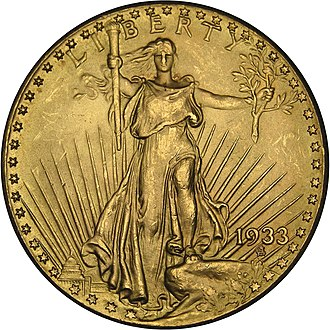
The 1933 double eagle is a gold coin of the United States with a denomination of 20 dollars. Though 445,500 pieces of this Saint-Gaudens double eagle were produced in 1933, they never entered official circulation and all except two were instructed to be melted. Yet, 20 more escaped the melt via theft, eventually landing in collectors’ hands before being reclaimed. Eight of these retrieved coins were subsequently destroyed, leaving only 14 of these exceptionally rare coins in existence today. Of these, only one, known as the Weitzman Specimen, is privately held. Since the coin was never publically released, owning a 1933 double eagle is unlawful, except for the Weitzman Specimen.
Two of the preserved coins are housed in the U.S. National Numismatic Collection, ten reside in the United States Bullion Depository at Fort Knox, and the remaining, previously mentioned coin, was sold in 2002 to private collector Stuart Weitzman (then anonymous) for US$7.59 million (equivalent to $12.2 million as of 2022). This was the second highest auction price ever fetched by a single U.S. coin. In June 2021, the same coin was auctioned again to an undisclosed buyer for a record-breaking US.8 million, making it the priciest coin ever sold.
The 1933 Double Eagle is one of the most famous and valuable coins in the world. It is a symbol of the Great Depression and the history of American coinage.
Mint year:1933
Original value: $20
Current value: $18.9 million
1794 Flowing Hair Dollar

The Flowing Hair dollar has the distinction of being the first dollar coin issued by the U.S. federal government. This coin, minted in 1794 and 1795, had its size and weight patterned after the Spanish dollar, a coin widely used in trade across the Americas.
The story of the Flowing Hair dollar starts in 1791, when a study by Alexander Hamilton prompted Congress to pass a joint resolution for the creation of a national mint. In the same year, President George Washington, in his third State of the Union address, advocated for a mint which was officially sanctioned by the Coinage Act of 1792. However, silver and gold coins weren’t minted until 1794. The Flowing Hair dollar, a design of Robert Scot, was first minted in 1794, and once again in 1795. By October 1795, the Flowing Hair dollar was replaced by the Draped Bust dollar design.
Only 1,758 1794 Flowing Hair Dollars were minted, and they are now some of the most valuable coins in the world. In 2013, the finest known example of the 1794 Flowing Hair Dollar was sold at auction for $10,016,875, setting a record for the highest price ever paid for a coin.
Mint year:1794
Original value: $1
Current value: $12 million
1787 Brasher Doubloon
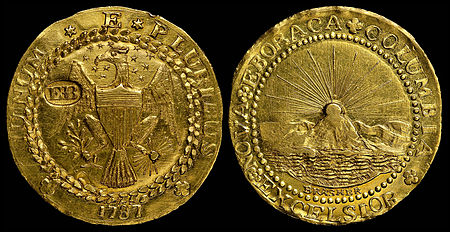
In 1787, Ephraim Brasher, a skilled goldsmith and silversmith, proposed a petition to the State of New York for minting copper coins. However, the state declined his proposal, choosing not to venture into copper coinage. Brasher was a well-respected craftsman, and his hallmark was well-esteemed across the United States. He marked not only his own coins but also other coins sent to him for assay proofing. Over the following years, Brasher minted several copper coins and a small number of gold coins.
The value of this coin, denominated as eight Spanish escudos or sixteen Spanish dollars ($16), underwent initial terminology confusion. It was initially dubbed the “double doubloon” before becoming known as the “Spanish doubloon.” To clarify, the $4 coin became commonly known as the doubloon, while the $16 coin was referred to as the doubloon of eight (escudos), a practice also adopted in Spanish America.
A surviving gold coin, weighing 26.6 grams and composed of 0.917 (22-carat) gold, was auctioned for 5,000 in March 1981.
On January 12, 2005, Heritage Auction Galleries auctioned all three varieties of Brasher Doubloons during their Florida United Numismatists U.S. Coin Auction, Platinum Night Session. The coins fetched $2,415,000 for the New York Style EB Punch on Wing NGC AU55, $2,990,000 for the unique New York Style EB Punch on Breast NGC XF45, and $690,000 for the less renowned but rare Lima Style Doubloon. In December 2011, the unique Brasher Doubloon, the first U.S. gold coin, was sold by rare-coin dealer Steven L. Contursi of Laguna Beach, California, to the Certified Acceptance Corporation (CAC) of Far Hills, New Jersey.
A Wall Street investment firm, wishing to remain anonymous, purchased it from Blanchard and Company of New Orleans, Louisiana, for almost $7.4 million, setting a record for a U.S.-minted coin. This record was surpassed in January 2021, when a Brasher Doubloon was sold by Heritage Auctions for $9.36 million, marking a new world record for a gold coin in a public auction.
Mint year: 1787
Original value: $20
Current value: $10-12 Million
1861 Paquet Liberty Head double eagle

In 1860, Anthony C. Paquet, the assistant engraver at the mint, crafted a new reverse design for the double eagle coin. It was distinguished by its tall lettering and extremely thin rim. However, in the early part of 1861, concerns were raised about the design’s durability due to the rim’s slimness. As a result, a telegraph was dispatched to the San Francisco mint instructing them to revert to the old Longacre reverse style. However, the message seemed to have taken a significant amount of time to arrive. By the time the message was received, the mint had already struck and released into circulation double eagles valued at $385,000 with the new 1861-S reverse design.
The 1861-S Paquet reverse double eagle was largely overlooked until its “rediscovery” in the 1930s. Several were found in European repositories of U.S. gold coins, and many were subsequently returned to the American coin market. Today, while rare, this coin is highly valued as a key issue within the Type One series, collected alongside the standard 1861-S double eagle. Clearly intended for circulation, this variety is undeniably a regular issue.
Mint year: 1861
Original value: $20
Current value: $7.2 million
1913 Liberty Head Nickel

The 1913 Liberty Head Nickel is one of the most famous and valuable coins in the world. It is a rare five-cent piece which was produced in extremely limited quantities unauthorized by the United States Mint, making it one of the best-known and most coveted rarities in American numismatics.
Only five 1913 Liberty Head Nickels are known to exist, and they are all in private hands. The coins were produced by a mint worker named William Johnson, who made them using dies from the 1912 Liberty Head Nickel design.
In 1972, one specimen of the five cent coin became the first coin to sell for over US$100,000; in 1996, another specimen became the first to sell for over US$1 million. A specimen was sold for US$3 million in a 2004 private sale, then resold for US$3.7 million at a public auction in 2010.
Mint year: 1913
Original value: $0.05
Current value: $5 million
1804 Dollar

The 1804 dollar, also known as the Bowed Liberty Dollar, is a coin of great significance produced by the United States Mint. Despite its 1804 date, all known specimens were minted during the 1830s or later. A total of fifteen authentic coins are currently known to exist. These special dollar coins were first manufactured as a part of proof coin sets intended as diplomatic gifts during Edmund Roberts’ visits to Siam and Muscat.
Roberts distributed these coins in 1834 and 1835. However, his death in Macau prevented him from delivering two additional sets intended for government representatives in Japan and Cochinchina. Apart from the 1804 dollars made for the diplomatic gifts, the Mint also produced a few for exchanges with collectors to acquire desirable pieces for the Mint’s coin collection. In 1842, numismatists became aware of the existence of the 1804 dollar when an illustration appeared in a publication authored by two Mint employees.
A year later, a collector managed to obtain one specimen from the Mint. Owing to the increasing demand from numismatists, Mint officials clandestinely produced a few more examples. These later strikes, however, were missing the correct edge lettering. Subsequent mintings included the correct lettering. Coins produced for the diplomatic mission, those surreptitiously struck without edge lettering, and those with the lettering are collectively known as “Class I”, “Class II”, and “Class III” dollars.
Since their discovery, 1804 dollars have consistently fetched high prices. By 1885, auction prices reached $1,000 and exceeded $30,000 by the mid-twentieth century. In 1999, a record was set when a Class I example sold for $4.14 million, marking the highest price ever paid for a coin at the time. Due to their high value, the 1804 dollars have often been the target of counterfeit attempts and other fraudulent practices.
Mint year: 1804
Original value: $1
Current value: $2-3 million
1792 Spanish Milled Dollar

The first coin minted by the United States Mint, and it helped to establish the value of the US dollar. Only a handful of coins are known to exist, and they are worth millions of dollars each.
Mint year: 1792
Original value: $1
Current value: $1-2 million
1822 Half Eagle

The 1822 Half Eagle holds a legendary status as the most sought-after and esteemed U.S. gold coin. When other notable rarities were selling for relatively modest sums, this coin exchanged hands at extraordinary prices. Only three specimens of this coin are known to exist: two are safeguarded in the Smithsonian Institution (one in the Mint Collection and the other in the Lilly Collection), while the third one is part of the Louis Eliasberg Collection.
The specimen in the Mint Collection has been part of its holdings since the 1830s. The Lilly specimen, acquired from Amon Carter Jr. in the early 1960s, is the renowned H. P. Smith-William Dunham specimen. It was first sold at the 1890 Parmelee Sale for $900, then fetched $2165 at the H.P. Smith Collection Sale in 1906, and finally broke records when it sold for $11,575 at the Dunham Sale.
The Eliasberg coin, the finest among the three specimens, was acquired by Mr. Eliasberg from Abe Kosoff in July 1945 for $14,000. All three specimens are in the Very Fine to Extremely Fine condition range, further enhancing their rarity and value.
Mint year: 1822
Original value: $5
Current value: $840,000
1853-O Seated Liberty Half Dime

Mint year: 1853
Original value: $0.50
Current value: $500,000
1894-S Barber Quarter

Mint year: 1894
Original value: $0.25
Current value: $300,000
The Barber Quarter, minted in locations like Philadelphia, New Orleans, and San Francisco, offers three 1894 varieties. The 1894-S from San Francisco is the rarest, constituting under 30% of all Barber Quarters made that year. Although a coveted collectible, many existing Barber Quarters show clear signs of age, challenging collectors seeking pristine pieces.
1937-S Washington Quarter with Doubled Die Obverse

This coin is one of the most valuable Washington quarters, due to a die error that caused the obverse to be doubled.
Mint year: 1937
Original value: $0.25
Current value: $250,000
1909-S VDB Lincoln Cent

The 1909-S VDB Lincoln Cent, a key variety of the U.S. one-cent coin, is recognized for its low mintage. This coin was struck by the United States Mint in San Francisco in 1909 and replaced the Indian Head penny as the first U.S. everyday coin to depict a real person. However, it sparked immediate controversy due to the engraving of the initials of Victor David Brenner, the coin’s sculptor, on the reverse side.
To commemorate Abraham Lincoln as the preserver of the Union, U.S. President Theodore Roosevelt commissioned a new design featuring Lincoln’s profile. The coins were originally set to be released on Lincoln’s 100th birth anniversary, February 12, 1909. However, the release was delayed to incorporate the phrase “In God We Trust,” and the coin was finally issued on August 2, 1909.
Just days after the coin’s release, production was halted on August 6, 1909, to eliminate Brenner’s initials (VDB) from the coin dies. The Philadelphia Mint (with no mint mark) and the San Francisco Mint (bearing the mint mark ‘S’) were responsible for minting the Lincoln cent. While the Philadelphia Mint produced 27,995,000 VDB pennies, the San Francisco Mint only minted 484,000, making this particular variant the scarcest in the series.
News of the coin’s discontinuation prompted Americans to form long queues to acquire these pennies, anticipating their potential value as collectibles. In cities across the U.S., people sought large quantities of pennies for resale. The frenzy was so intense in New York City that police had to be deployed to manage the crowds.
Mint year: 1909
Original value: $0.01
Current value: $200,000
1909-S VDB Lincoln Cent, without the “VDB” initials
This coin is one of the most valuable Lincoln cents, due to a die error that caused the “VDB” initials to be omitted from the obverse.
Mint year: 1909
Original value: $0.01
Current value: $100,000
1856 Flying Eagle Cent

The Flying Eagle cent, a one-cent coin minted by the United States Mint, was first struck as a pattern coin in 1856 and later circulated in 1857 and 1858. James B. Longacre, the Mint’s Chief Engraver, designed the coin, modeling the flying eagle on the work of his predecessor, Christian Gobrecht.
By the early 1850s, the large cent (roughly the size of a half dollar) that the Mint was producing had become both commercially undesirable and costly to manufacture. After testing various sizes and materials, the Mint settled on a new, smaller cent made of an alloy comprising 88% copper and 12% nickel. After creating patterns with an 1856 date and presenting them to lawmakers and officials, Congress officially approved the new coin in February 1857.
The new cent was circulated as a replacement for the worn-out Spanish colonial silver coin that had previously been in circulation in the U.S., as well as its larger predecessor. However, the Mint produced so many of these cents that they clogged commercial channels, especially since they were not legal tender and no one was obligated to accept them. The eagle design did not imprint well and was eventually substituted in 1859 by Longacre’s Indian Head cent design.
Mint year: 1856
Original value: $0.01
Current value: $100,000
1857 Flying Eagle Cent

The first small-sized US cent, this coin is one of the most popular among collectors.
Mint year: 1857
Original value: $0.01
Current value: $100,000
1914-D Lincoln Cent

The 1914-D Lincoln Cent holds a prestigious position among the Lincoln Cent series due to its status as a key date. With a relatively low mintage of approximately 1.2 million, it is considered a rare find. This rarity becomes even more pronounced when contrasted with the over 75 million Lincoln Cents minted in Philadelphia in the same year. However, its scarcity and the consequent high market value have led to an unfortunate prevalence of counterfeits. As a result, it is strongly advised to seek authentication when acquiring a 1914-D Lincoln Cent.
Mint year: 1914
Original value: $0.01
Current value: $100,000
1916 D Lincoln Cent with Doubled Die Obverse

This coin is one of the most valuable Lincoln cents, due to a die error that caused the obverse to be doubled.
Mint year: 1916
Original value: $0.01
Current value: $100,000
1950-D Jefferson Nickel with Doubled Die Obverse
This coin is one of the most valuable Jefferson nickels, due to a die error that caused the obverse to be doubled.
Mint year: 1950
Original value: $0.05
Current value: $100,000
1955 Doubled Die Lincoln Cent

The 1955 doubled die cent signifies a unique variant originating during the production of the one cent coin at the U.S. Mint in 1955.
The formation of a modern coin die involves the application of multiple strikes from a working hub to imprint the incuse image that will eventually be used to mint coins. In an unexpected turn of events in 1955, a working obverse die at the Philadelphia Mint got misaligned during its second strike from the working hub, leading to a duplicated image.
This double-striking phenomenon primarily affected the date and inscriptions, with minor doubling and a noticeable detail loss observed on Lincoln’s bust. All coins minted from this particular die displayed these doubled features. Approximately 40,000 of these coins were minted, all during a single night shift at the Philadelphia Mint. Around 20,000 to 24,000 of these pennies ended up in circulation post the minting error.
The 1955 doubled die is considered one of the most renowned die variants in U.S. coinage. It is a rarity to find one in flawless mint condition, as the majority were discovered while already in circulation. Over time, numerous counterfeits of this coin have been unearthed. Collectors are recommended to solicit expert opinion before purchasing such coins, especially if they aren’t certified by reputable numismatic certification companies.
A variant that often gets mistaken for the 1955 doubled die is the “Poor Man’s Doubled Die” cent, which is a product of die deterioration doubling. The distortion and erosion of the design on a worn die results in parts of the design, such as the last digit of the date, appearing doubled. Being more common than the actual doubled die, this variant typically sells for just a few dollars.
Mint year: 1955
Original value: $0.01
Current value: $50,000
1922 Peace Dollar with Overdate
This coin is one of the most valuable Peace dollars, due to a die error that caused the date to be overstruck.
Mint year: 1922
Original value: $1
Current value: $50,000
1943 Lincoln Cent struck on a copper-nickel planchet

This coin is one of the most valuable Lincoln cents, due to a minting error that caused it to be struck on a copper-nickel planchet instead of a steel planchet.
Mint year: 1943
Original value: $0.01
Current value: $35,000
1943 Lincoln Cent struck on a Cuban centavo planchet

Similar to the above, this coin is valuable due to a minting error that caused it to be struck on a Cuban centavo planchet instead of a steel planchet.
Mint year: 1943
Original value: $0.01
Current value: $35,000
Foreign Coins Worth Money
Turns out, other countries have currencies too! Let’s check out some of the most valuable foreign coins from other parts of the world:
Mexican Coins Worth Money
Now let’s get to the part that matters most for this page’s search intent: foreign coins worth money. These are coins from outside the United States that collectors may value because of rarity, age, silver or gold content, historical importance, low mintage, mint errors or strong demand.
I would not assume every foreign coin is valuable, but I also would not ignore one just because I do not recognize it. The country, date, denomination, mint mark and condition can completely change the story.
Below are examples of foreign and world coins that are worth knowing, starting with Mexican coins and then moving into other major collecting areas.
1823 8 Reales “Reina Victoria”
This coin from Mexico features a bust of King Ferdinand VII but was nicknamed “Reina Victoria” due to its striking resemblance to the British queen. It is prized among collectors for its historical connection and the intricate detailing of the royal portrait.
Mint year: 1823
Original value: $8
Current value: $1 million
1732 8 Reales “Pillar”

Known as the “Pillar Dollar,” this Spanish coin displays two pillars representing the Pillars of Hercules, a maritime symbol of Spain’s reach. It became widely circulated in the Americas and Asia, influencing the design of modern currency like the U.S. dollar.
Mint year: 1732
Original value: $8
Current value: $750,000
1811 8 Reales “Zitacuaro”

Minted during Mexico’s War of Independence, this coin bears the name of Zitácuaro, an insurgent stronghold. It’s valued for its historical context and as a symbol of resistance against Spanish rule.
Mint year: 1811
Original value: $8
Current value: $600,000
1822 8 Escudos

Mint year: 1822
Original value: $16
Current value: $500,000
This gold coin from Mexico is highly sought after due to its association with the First Mexican Empire under Emperor Agustín de Iturbide. Its rarity and regal design make it a favorite among numismatists.
1910 20 Pesos “Moctezuma”
Struck during the Mexican Revolution, this gold coin features an image of the Aztec Emperor Moctezuma. It symbolizes national pride and is a key piece in Mexican numismatic history.
Mint year: 1910
Original value: $20
Current value: $400,000
Canadian Coins Worth Money
Canadian coins are another foreign coin category I would check carefully, especially older cents, silver coins, low-mintage issues, mint varieties and coins with design changes. Some Canadian coins look ordinary at first, but small details like a dot, shoulder fold, date or condition can make a big difference.
When you check Canadian coins, start with the date, denomination, mint variety and overall condition. I would also compare recent sold prices because the same coin can have very different value depending on grade and collector demand.
The examples below show why Canadian coins can be worth money and what details you should look for before selling, spending or ignoring one.
1936 Canadian “Dot” Penny

One of the rarest Canadian coins, this penny features a small dot under the date, distinguishing it from others. It was minted as an experimental issue and is a holy grail for collectors.
Mint year: 1936
Original value: $0.01
Current value: $400,000
1925 Small 1-Cent
Mint year: 1923
Original value: $0.01
Current value: $3,374
This Canadian penny is notable for its limited mintage, making it one of the scarcest regular-issue Canadian coins. Its value is enhanced by its elusive nature in high grades.
1955 No Shoulder Fold (NSF) Penny

Mint year: 1955
Original value: $$0.01
Current value: $5,500
This Canadian coin is characterized by its weakly struck shoulder folds in the effigy of Queen Elizabeth II. It is a rarity for collectors due to its misstep in production.
1923 Small 1-Cent

Mint year: 1923
Original value: $0.01
Current value: $2,700
A low-mintage Canadian penny that remains one of the rarest in the series. Its scarcity in top condition makes it highly desirable for coin enthusiasts.
1953 Shoulder Fold (SF) Penny
The SF penny corrected the design flaw in the 1955 NSF penny by properly striking the shoulder folds on Queen Elizabeth II’s portrait. It’s sought after for its historical context in Canadian minting.
Mint year: 1953
Original value: $0.01
Current value: $2,000
Chinese Coins Worth Money
Chinese coins are a major part of the world coin market, especially older silver dollars, dragon coins, provincial issues, gold coins and scarce varieties. Some Chinese coins are valuable because of rarity, history and collector demand, while others are common and need careful identification before you assume they are worth money.
When I check Chinese coins, I look closely at the date, province, denomination, metal, design details and condition. I would also be extra careful with authentication because valuable Chinese coins are often copied or altered.
The examples below show why Chinese coins can be worth serious money and why small design differences can matter so much.
1903 Fengtien Tael

The 1903 Fengtien Tael is a silver coin that was minted in Fengtian, China (now Shenyang, Liaoning Province). It is one of the rarest and most valuable coins in the world, and only one example is known to exist.
The coin was minted in 1903, during a period of political and economic turmoil in China. It features a portrait of the Qing Emperor Guangxu on the obverse and a dragon on the reverse. The coin is made of .990 fine silver and weighs 37.3 grams.
The 1903 Fengtien Tael was originally owned by Eduard Kann, a renowned numismatist. It was sold at auction in 2022 for over $6.9 million, setting a record for the highest price ever paid for a Chinese coin.
Mint year: 1903
Original value: $20
Current value: $6.9 million
1897 Kuang-Hsu Proof Dollar

A proof issue from the reign of Emperor Kuang-Hsu, this coin is rare and admired for its high-relief designs and historical significance as a symbol of late Qing Dynasty monetary reforms.
Mint year: 1897
Original value: $1
Current value: $240,000
1853 $1 “Cash”
Mint year: 1853
Original value: $1
Current value: $100,000
A Chinese cash coin with a square hole in the center, it was widely used during the Qing Dynasty. Its simple yet iconic design reflects traditional Chinese coinage.
1914 Yuan Shi Kai One Dollar Silver, Hat Touching Brim

Mint year: 1914
Original value: $1
Current value: $50,000
This variation of the Yuan Shikai dollar features the hat of the military leader touching the coin’s rim, a rare design change that makes it a valuable collectible.
1916 Yuan Shi Kai One Dollar Silver, Flying Dragon

Mint year: 1916
Original value: $1
Current value: $50,000
This Chinese coin features Yuan Shikai and a mythical dragon, symbolizing power and authority. The design is rare, making it a standout in Chinese numismatics.
British Coins Worth Money
British coins are worth checking because the United Kingdom has a long history of gold, silver and copper coinage. Some British coins are valuable because of age, royal history, low mintage, precious metal content, condition or collector demand.
When I check British coins, I look closely at the monarch, date, denomination, mint details, metal and condition. I would also be careful with very old or high-value pieces because authentication matters, especially when a coin has a famous design or strong auction history.
The examples below show why British coins can be worth money and what details you should compare when checking your own coins.
1797 Gold Guinea

A British gold coin from the reign of King George III, the 1797 Guinea is renowned for its elegant design and representation of British economic strength in the 18th century.
Mint year: 1797
Original value: $1
Current value: $2.5 million
1820 Maundy Penny

Part of the Maundy Money tradition in Britain, this small silver coin was distributed during Easter ceremonies. Its association with royal generosity makes it a cherished collectible.
Mint year: 1820
Original value: £0.01
Current value: $100,000
1933 George V Penny

One of the rarest British coins, this penny was not officially released for circulation, with only a handful known to exist. Its rarity has made it legendary among collectors.
Mint year: 1933
Original value: £0.01
Current value: $50,000
1970 Victoria Sixpence

This proof-only coin was issued in the final year of the British sixpence. It marks the end of an era for this denomination and is highly sought after in pristine condition.
Mint year: 1970
Original value: £0.06
Current value: $10,000
Other Foreign Coins Worth Money
Some foreign coins do not fit neatly into one country category, but they are still worth studying because of their history, metal content, rarity and collector demand. This is where world coins can get especially interesting.
When I check coins from older empires, former kingdoms or historic regions, I pay close attention to the date, script, ruler, denomination, metal and authenticity. Some of these coins can be extremely valuable, but they can also be difficult to identify without careful research.
The example below shows why rare world coins can be worth serious money when history, gold content and collector demand all come together.
Umayyad Gold Dinar (Umayyad Caliphate)

The Umayyad Gold Dinar was the first gold coin issued by the Umayyad Caliphate. It was introduced in 77 AH (696/697 AD) by the caliph Abd al-Malik ibn Marwan. The coin is made of pure gold and weighs 4.25 grams. It has a diameter of 21 mm and a thickness of 2 mm.
The obverse of the coin features the Arabic inscription “Muhammad is the messenger of God, who sent him with guidance and the religion of truth that he might make it supreme over all religions.” The reverse of the coin features the Arabic inscription “In the name of God, this dinar was struck in the year seven and seventy.”
The Umayyad Gold Dinar was widely circulated throughout the Islamic world. It was used as a unit of currency and as a symbol of the Umayyad Caliphate. The coin is still highly prized by collectors today.
Mint year: 696 CE
Original value: £4
Current value: $5 million
Don’t have any of these? Your Coins Still Might be Worth Something!
Let’s face it. You’re pretty unlikely to find any of these coins in your possession. But that doesn’t mean what you DO have in your hands isn’t worth anything. In fact, many old coins can fetch some pretty high prices if they’re in good condition, making sifting through your collection definitely worthwhile.
And the best news is that you don’t need to work out the value yourself. My scrap silver calculator will help you identify exactly how much you’re likely to get from selling your coins – and, what’s more, I’ll be releasing a calculator dedicated to coins over the next few weeks.
Stay tuned!
Where to Buy Rare Coins
OK, so some of these – especially those coins worth millions – might be really rare, but fortunately for us, there are plenty of ways to buy the coins that are still out there and up for grabs.
My first port of call is Apmex. For the size of its catalog and assurances of quality, there’s really no better place.
Next, I always check out what the auctioneers at Whatnot have to sell – I’ve found that there are tons of good deals to be had. You can get $15 of Whatnot credit with my link. What are you waiting for?
Heritage Auctions is a great option as well, as are the good old-fashioned estate sales and coin shows in your city.
The Bottom Line
Hopefully, this list of coins worth money has given you a good idea of what a rare coin can really mean. If you’re a seasoned numismatist, these numbers aren’t new. If you’re a beginner, get excited – you never know what’ll fall into your hands.
Frequently Asked Questions About Foreign Coins Worth Money
What Foreign Coins Are Worth Money?
Foreign coins can be worth money when they have rarity, silver or gold content, low mintage, strong condition, mint errors or collector demand. I would check the country, date, denomination, mint mark, metal and recent sold prices before deciding whether your foreign coin is valuable.
How Do I Know If A Foreign Coin Is Valuable?
To know if a foreign coin is valuable, start by identifying it correctly. Check the country, date, denomination, mint mark and metal first. Then inspect the condition and compare your coin with recent sold listings. I would not rely only on age because many old foreign coins are still common.
Are Old Foreign Coins Always Worth Money?
No, old foreign coins are not always worth money. Some old coins were made in large numbers and are easy to find today. A coin usually needs something extra, such as precious metal content, rarity, a better date, a mint error or strong collector demand, to be worth more.
What World Coins Should I Look For?
I would look for silver coins, gold coins, low-mintage coins, colonial coins, error coins and coins tied to major historical periods. Mexican, Canadian, Chinese and British coins are all worth checking carefully, but the exact date, condition and variety matter more than the country alone.
Are Foreign Silver Coins Worth Money?
Foreign silver coins can be worth money because they may have melt value and collector value. The silver content gives the coin a base value, but the final price can be higher if the coin is rare, in strong condition or popular with collectors. You can use my scrap silver calculator to estimate metal value first.
Should I Clean Foreign Coins Before Selling Them?
No, I would not clean foreign coins before selling them. Cleaning can scratch the surface, remove original toning and lower collector value. If you think a coin might be valuable, handle it by the edges, store it safely and research it before making any changes.
Where Can I Sell Foreign Coins?
You can sell foreign coins through coin dealers, coin shows, online marketplaces, auction platforms or collector groups. I would identify the coin first, check recent sold prices and take clear photos before listing it. Better coins may deserve a second opinion from a specialist before you sell.
What Is The Best Way To Start Checking Coins Worth Money?
The best way to start is to sort your coins by country, then check the date, denomination, mint mark, metal and condition. I would separate anything silver, gold, unusual, old or hard to identify so you can research those pieces more carefully.
Further Reading
- How To Start A Coin Collection: Build a simple collecting habit before buying, selling or organizing coins.
- What Is Coin Condition?: Learn why wear, scratches, cleaning and eye appeal can change a coin’s value.
- Where I Buy Coins And Currency: See the places I use when buying collectible coins and paper money.
- How Much Are Ancient Roman Coins Worth?: Compare another type of historic world coin that collectors often research.
- How To Spot Fake Silver Coins: Learn what to check before trusting a silver coin’s value.
- Silverpicker Coin Values: Browse coin value guides when you want to research specific dates and denominations.


